
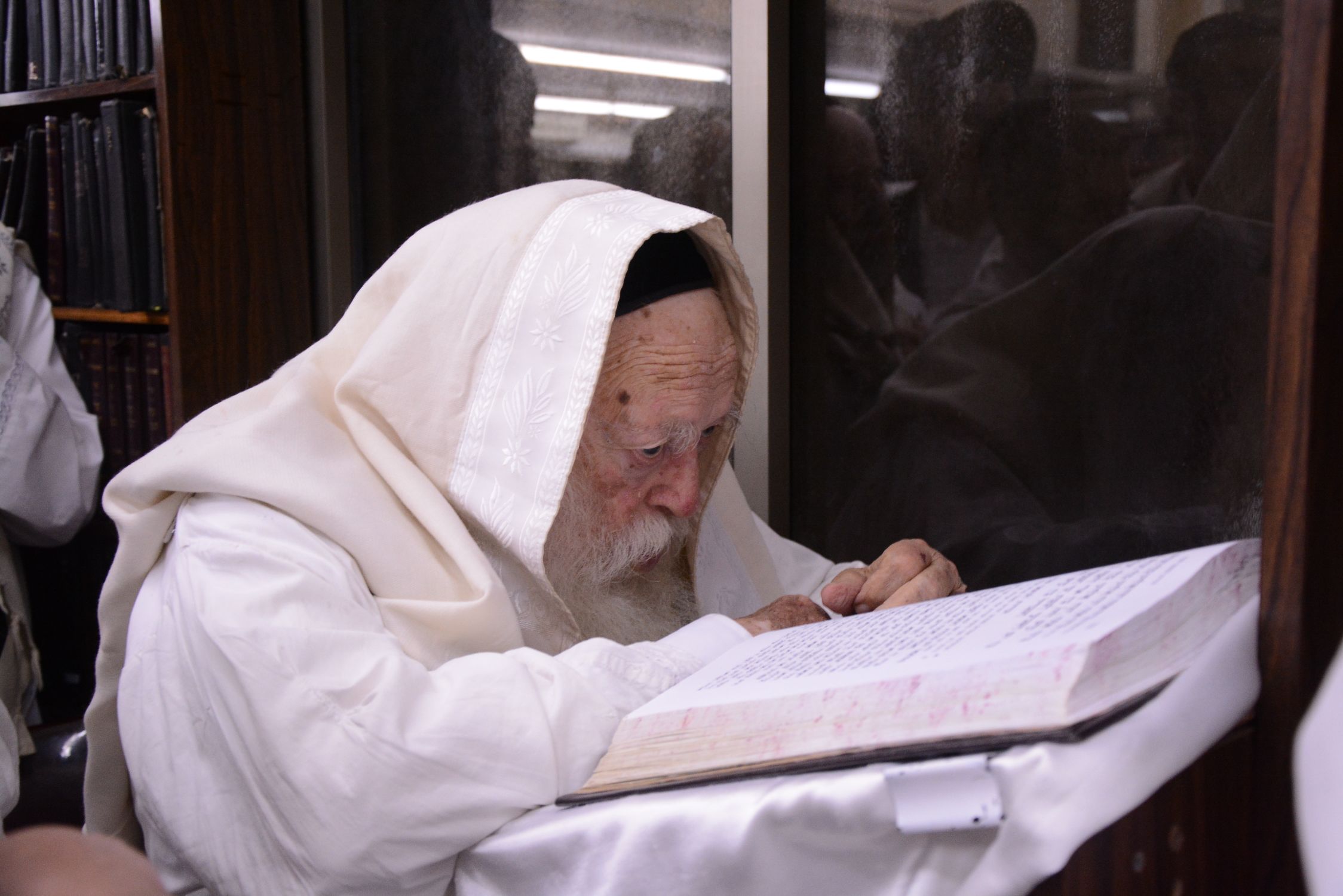
The Minhagim and Conduct of Maran, zt”l, on Rosh Hashanah
As recorded during his lifetime
On Erev Rosh Hashanah, Maran would rise very early for Selichos and would say the entire Selichos without skipping any parts. Until his strength became greatly weakened in his later years, he would serve as the shaliach tzibbur for Selichos on Erev Rosh Hashanah, Tzom Gedaliah, and Erev Yom Kippur.
After davening Shacharis k’vasikin, as was his regular practice, he would perform Hataras Nedarim. He was not particular that the members of the beis din be qualified dayanim, and his sons, shlita, would annul his nedarim.
Afterward, he would make a public siyum on Maseches Kiddushin—marking the completion of half of Shas—and distribute wine and cake so that those present would not have to fast.
After Minchah Gedolah, he would take a haircut and immerse in the mikvah in honor of Yom Tov.
On Rosh Hashanah, Maran did not wear a kittel.
After candle lighting, he would go down to the beis midrash and recite the piyut Achot Ketanah, as printed in the machzor. This is the piyut containing the tefillah: “May the year and its curses come to an end; may the new year and its blessings begin.”
He would then begin saying Tehillim. Throughout the entire Aseres Yemei Teshuvah, from Rosh Hashanah through Yom Kippur, he would complete the entire Sefer Tehillim each day, thereby finishing Tehillim ten times.
After Maariv, he would bless every member of the tzibbur with the words, “L’shanah tovah tikaseiv v’seichaseim.” In his later years, when the tzibbur had grown very large, bli ayin hara, he no longer had the strength to recite the entire bracha to each person individually and would simply wish everyone, “A gut yohr.”
He would then go upstairs to his home and make Kiddush over wine. When reciting Shehecheyanu, he would have in mind that the bracha should also cover the new fruits on the table. On the second night of Rosh Hashanah, he was particular to have a new fruit on the table in order to resolve the halachic question concerning the Shehecheyanu in Kiddush, and he would specifically have the new fruit in mind.
During the Rosh Hashanah seudah, he would wear his shtreimel, as he did on every Yom Tov.
After washing and reciting Hamotzi, the simanim would be brought before him: a pomegranate, an apple dipped in honey, gourd, black-eyed peas, leek, beets, carrots, and the head of a fish. He would first recite Borei Pri Ha’eitz, having in mind to exempt all the fruits. He would then recite Borei Pri Ha’adamah, having in mind to exempt all the vegetables. For each siman, he would recite the appropriate Yehi Ratzon printed in the machzor, without Shem u’Malchus. He followed the same practice on the second night of Rosh Hashanah.
In the morning, Maran would daven k’vasikin. In earlier years, he was careful to stand during every piyut recited while the Aron Kodesh was open. In his later years, when his strength had diminished, he would remain seated.
During Chazaras Hashatz, he would not say Tehillim, so as not to make an interruption.
During the break between Shacharis and tekias shofar, he would learn his regular daily sedarim or say Tehillim. He would not make Kiddush or taste anything before the tekios.
Regarding the tekios, he was particular that they be blown according to the shittah of the Chazon Ish. During the tekios d’meyushav, there was to be no break whatsoever between the shevarim and the teruah—not even enough time to take a breath. Rather, they were to be sounded almost as one continuous unit. During the tekios d’me’umad, however, there was a pause long enough to take a breath.
If the baal toke’a did not succeed in doing this properly, Maran would request after davening that another thirty kolos be blown for him, with no break between the shevarim and the teruah.
He was careful not to speak from the beginning of the tekios d’meyushav until the completion of all the tekios at the end of davening. However, to the best of my recollection, he did say Tehillim during this time.
After davening, he would wish everyone “Gut Yom Tov,” and then go upstairs to his home to make Kiddush. He was particular to eat the seudah before chatzos.
On both days of Rosh Hashanah, he was careful not to sleep before chatzos. After Minchah Gedolah, however, he was not particular to refrain from sleeping, as is brought in the name of the Arizal.
After Minchah Gedolah, he would go to a body of water containing fish to recite Tashlich. He would say the entire nusach as printed in the machzor, together with the tefillos of the Chida. When the first day of Rosh Hashanah fell on Shabbos, he would recite Tashlich on the second day of Rosh Hashanah.
In earlier years, he would go to the Yarkon River to say Tashlich. Afterward, he would go near City Hall, where there was an artificial lake containing fish. In his later years, when his strength had declined, he would go to the home of his son, Hagaon Rav Avraham Yeshaya, shlita, who would prepare an aquarium with fish for him, and Maran would recite Tashlich there.
On the first day of Rosh Hashanah, he was particular to eat a seudah shelishis immediately after Tashlich, so that he would still be able to eat the Yom Tov seudah on the second night with an appetite. This was in keeping with his practice every Erev Shabbos and Erev Yom Tov not to eat late in the day.
Rabbeinu was particular to eat three seudos on every Yom Tov, as well as a Melaveh Malkah following Yom Tov.